
Better information can change school choices—and schools
When more families act on better information, popular schools can fill up—and schools can gain a stronger reason to improve. Both responses shape what an information policy can achieve.
Give a few families better information about nearby schools, and they may find better places for their children. Give the same guidance to families across a city, and those places may fill up.
But schools can respond, too. If more parents pay attention to academic quality, improving it becomes a stronger way to attract students. A program that begins by changing what families know can end up changing who gets a seat and how good the schools are.
These responses pull in different directions. Competition for limited seats can reduce the gains from better information. Schools’ efforts to improve can add to them. Which force is stronger is something we need to learn about the school system, rather than assume from the success of a small pilot.
This is the question behind our research in Chile: what happens when an information program becomes large enough to change the choices people face?
Start with a decision families were already making
Parents choosing a primary school have practical questions. Which schools are nearby? How do their academic results compare? What do they cost? How far would a child have to travel?
Chile already published school performance data. Our intervention put those data into a form families could use: a personalized report card comparing nearby schools on test scores, fees, and location, accompanied by a map. A short video explained why school quality could matter for a child’s future opportunities.
We delivered the package at parent meetings through Fundación Integra, a public preschool network serving predominantly low- and lower-middle-income families. The randomized study took place in 2010, with 133 participating preschools across three regions of Chile. It used a setting where families were already gathering, around a decision they already had to make.
Among families who had not yet enrolled their child, those offered the information chose schools with stronger academic results and higher estimated value added—a measure of the school’s contribution to learning after accounting for differences in its students. They also traveled somewhat farther and were more likely to choose a school that charged fees.
Following the children in administrative records, we found a gain in learning: in that same group of families, children offered the intervention scored about 0.2 standard deviations higher in fourth grade. Later test results were positive but less precise, with smaller samples shaped by who took the tests.
That gives us a reason to take this kind of guidance seriously. It also brings us back to the harder question: what would happen if many more families received it?
Good advice can run into a full classroom
A family in a small trial may be able to act on new information without noticeably changing anyone else’s options. Across a city, that becomes harder. Families can learn about the same schools and compete for the same seats.
To explore this, we combine the experiment with a model of school choice and competition covering 53 urban school markets. The experiment tells us how the information changes families’ choices. The model lets us ask what those choices could produce when the program expands, popular schools fill up, and admissions rules determine who gets in.
In our main simulation, adding limited seats and centralized assignment removes about two-fifths of the projected gain in the quality of schools attended for the disadvantaged families shown below. Families have better information, but some cannot get a place at the school they now prefer.
It would be easy to stop there and conclude that an information program loses much of its promise as it grows. That would leave out the schools’ response.
Schools have a reason to respond
When academic quality matters more to families’ decisions, schools face a different incentive to provide it. Improving quality may attract students who would otherwise go elsewhere. That response can also improve the school a child already attends.
In the model, allowing private schools to adjust quality roughly restores the gains lost to competition for seats. The three scenarios in the figure show the sequence: families choose differently; limited seats restrict those choices; schools respond to the change in demand.
The figures focus on disadvantaged families in the target population who qualify for Chile’s targeted school voucher, known as SEP.
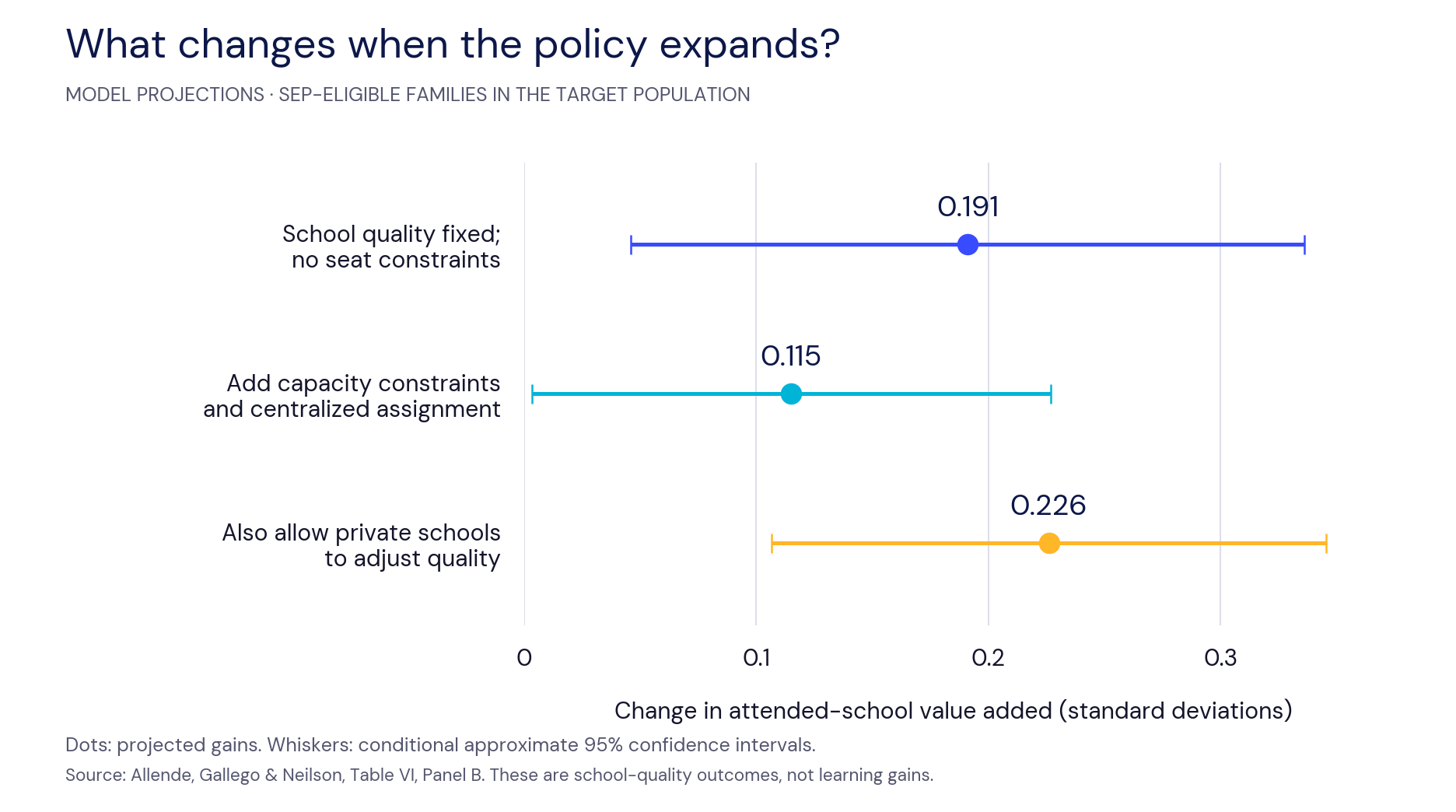
The final projected gain is close to where we started. It is slightly higher, but the difference is not statistically significant. The important finding is that two substantial responses can offset one another. Looking only at families’ choices would miss the competition for seats. Looking only at that competition would miss the incentive for schools to improve.
These are projections of school quality, rather than predictions of children’s test-score gains. The model carries forward the experiment’s evidence on how families choose; it does not extrapolate the fourth-grade learning effect. It allows private-school quality to change while holding fees, capacity, the set of schools, and public-school quality fixed. If improving quality becomes more expensive, the projected gains are smaller.
The balance could look different in another school system. What matters is recognizing both responses before deciding what a successful pilot promises at scale.
A better next test
We would want a larger experiment to measure those wider effects. That takes care, because schools serve families from several neighborhoods. If a school improves in response to an information program, children whose families never received the guidance may benefit too. If a popular school fills up, other families may lose access.
An evaluation needs to follow these connections. The paper uses an approximation from the model to compare geographic designs for a future trial, balancing spillovers between treatment and comparison areas against the need to measure effects reliably. That exercise guides a next test; it does not replace one.
For ConsiliumBots, the implication starts with the tools we build: make information useful for a particular family’s decision, and get it to them while they can still act. As more families use that guidance, we also need to follow what happens to the opportunities they are choosing among.
Helping one family find a better school is a meaningful result. A policy reaching many families should also be judged by what happens to access and to the schools themselves.
Explore the project: Visit the project website for the experiment, interactive results, and online appendix.
Read the latest paper: Claudia Allende, Francisco Gallego, and Christopher Neilson, Approximating the Equilibrium Effects of Informed School Choice, ConsiliumBots Working Papers no. 01. Also available as NBER Working Paper 35837.